Whois privacy
What is Whois privacy
When a domain name is registered, the registrar requires your full name, address, phone number and email address to be provided. This information is then entered into the Whois database and was traditionally made publicly available to anyone on the internet to search for and utilise in any which way they wish. With Whois Privacy, these details would be masked, so access to this information is restricted from public consumption, but would still be available to law enforcement officers.
Some of the main benefits of masking your whois data are reducing spam, reducing identity theft and concealing your physical location.
Whois before GDPR
.uk domains
Before the introduction of GDPR, if you registered a .UK domain via Nominet then all registrant details would be published by default. Non-trading individuals could opt out of having their address listed publicly via the Whois privacy service, free of charge, but the rest of their personal data would still be available.
Other TLDs
Similarly, if you held a .com domain name or similar TLD such as .org, .net, .info, .biz, .eu, .in, .io, etc then your details would also be shared as standard, but you would have the option to mask your personal data entirely using the Whois Privacy service, available at an additional fee.
Current regulations
As of May 25th 2018, GDPR has come into force meaning that as standard, all domains registered via Layershift have the below information hidden from public consumption:
- Registrant name
- Registrant address
- Registrant telephone number
- Registrant email address
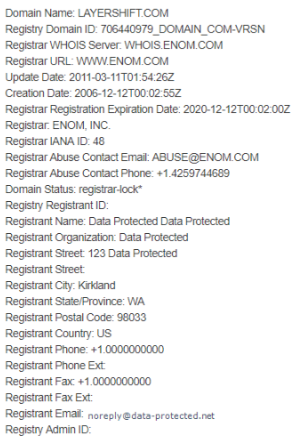
This applies for all new and existing domain registrations, with minor variations depending on the specific TLD.
For more details on how to register a new domain, please see our article about domain registration.